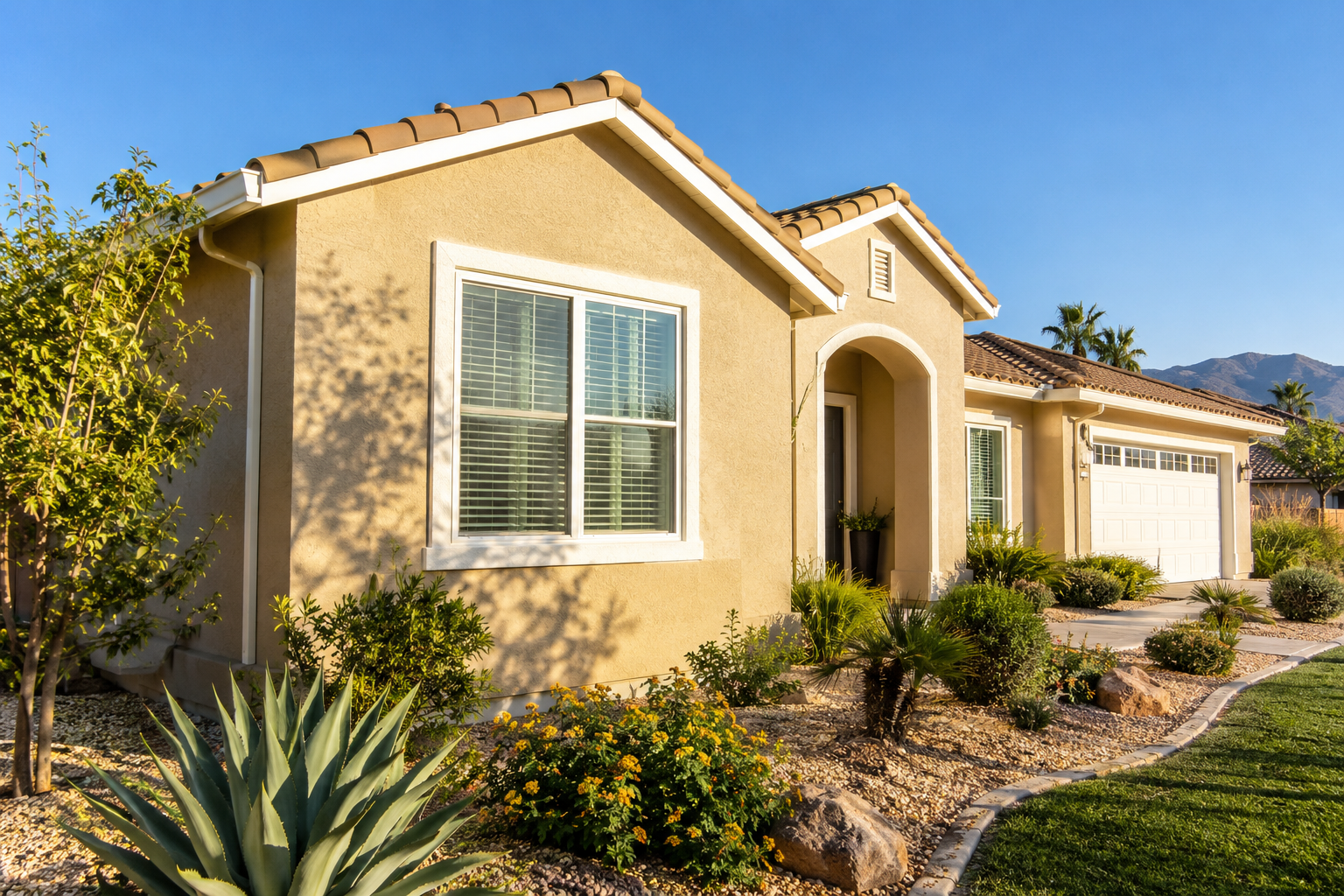
Does your exterior need repainting, or just a refresh? How to tell
By Aaron Urbina Marquez · September 21, 2026 · 7 min read
Separate dirt, isolated wear, color concerns, and coating failure before choosing between targeted work and a broader repaint.
So let's face it, do you need repainting, or just a refresh? That question comes up for a lot of Inland Empire homeowners.
Usually it comes up when the house starts to look tired from the curb, but nothing is obviously falling apart.
(Tired is a feeling. Peeling is a fact. They are not the same thing.)
The short answer is: it depends on what is actually happening to the existing finish — not just on how tired the house looks.
Dirt, isolated wear, color concerns, and coating failure are four different problems. And they point to four different scopes of work.
👉 Apply this: a refresh is a scope decision, not a technical diagnosis — and the right approach depends on the condition of the coating, not on a guess from the street.
Wait — what do you actually mean by "refresh"?
Start by naming what "refresh" would actually include. That word means different things to different people, and that difference is where most misunderstandings start.
For one homeowner, a refresh means a thorough cleaning and a fresh coat on the trim. For another, it means repainting one side of the house that gets the most sun.
For a third, it means touching up a few worn spots and leaving the rest alone. None of those is wrong — but they are not the same job.
And they should not be priced or compared as if they were. Before you ask for a refresh, write down which surfaces you mean.
The whole exterior, one elevation, trim only, or specific patches? An elevation, by the way, is just one side of the house — a plain word for a simple idea.
A refresh should not be described as a complete repaint if most surfaces stay as they are. And a complete repaint should not be sold as a refresh if it only covers part of the house.
👉 Apply this: clear boundaries protect both sides, so write down your version of "refresh" before anyone quotes it.
What does a safe look-around tell you?
Look closely before choosing a solution. From accessible ground-level areas — no ladders, no climbing onto roofs, no reaching beyond what is safe.
Compare sheltered and exposed sections of the house. Sun-facing walls, south and west elevations, and areas near sprinklers or soil often wear very differently from shaded, sheltered walls.
That comparison tells you a lot. Work through what you see, one category at a time:
- Dirt on a sound finish may call for cleaning. If the coating underneath is intact and the problem is mostly grime, pollen, or dust, washing may be all that is needed to judge the real color and condition — and cleaning should come before any color decision, because you cannot judge a dirty finish fairly.
- Isolated trim wear may support a limited project. If the walls look sound and only trim, fascia, or a door frame shows wear, a targeted trim project may be worth discussing, rather than repainting everything.
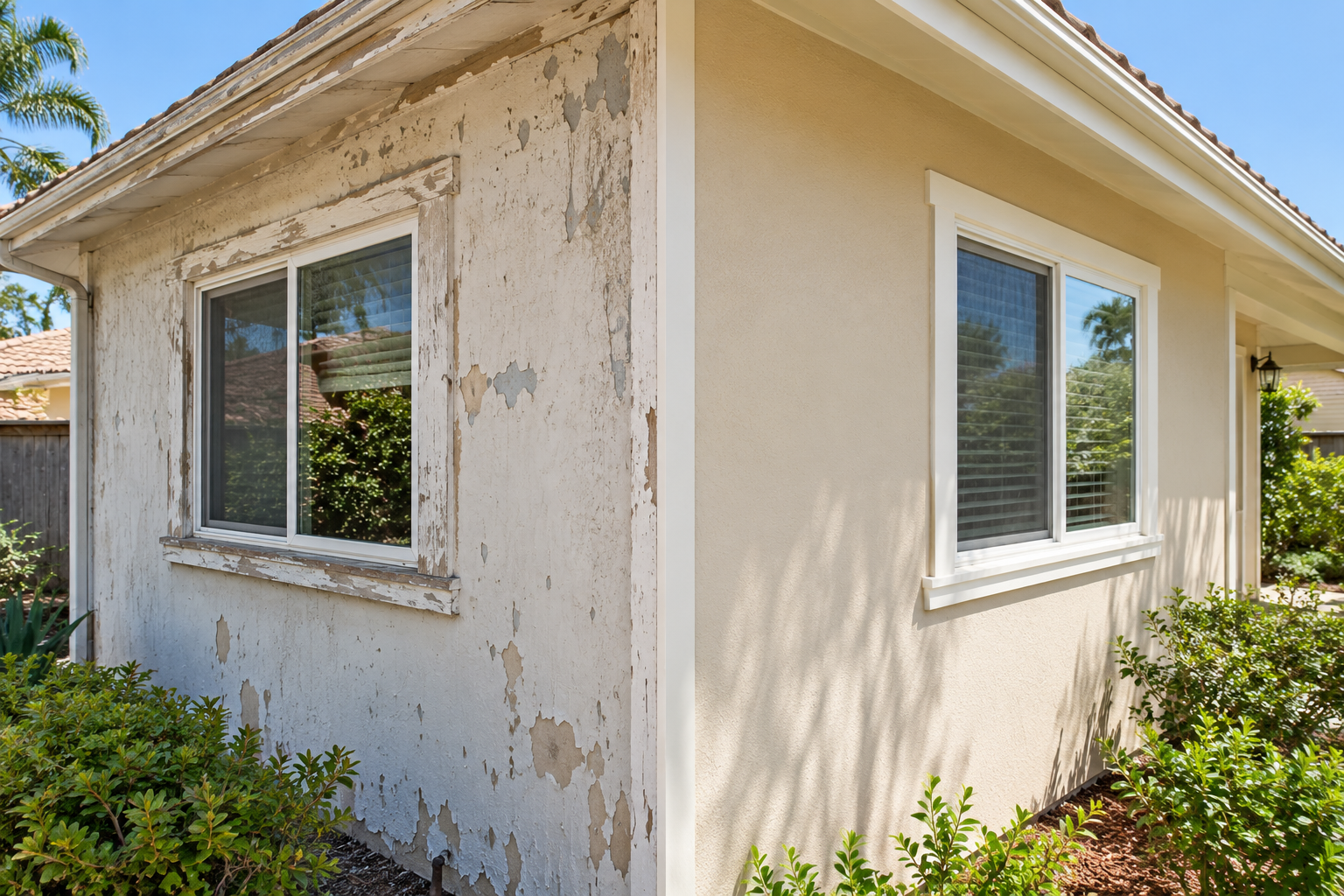
- Widespread peeling or exposed material needs broader review. Peeling across multiple walls, or bare material showing through, is not a touch-up problem — it is a coating problem, and it needs a broader conversation about preparation and scope.
- Recurring stains or bubbles need investigation. A stain that keeps coming back, or paint that bubbles, usually has a cause behind it — moisture, a surface issue, or a previous coating problem — and that cause should be understood before another coat goes on, or the same problem will likely return.
- Soft material needs repair evaluation, not simply another coat. If wood or other material feels soft, damaged, or unstable, painting over it does not fix it. Repair should be evaluated first, and the scope should say how repairs will be handled.
Photos help here, but they do not tell the whole story. Photos document what you can see, but they do not always show adhesion or hidden damage.
Adhesion just means how well the paint grips the surface underneath. (And a photo cannot grip anything, unfortunately.)
👉 Apply this: that is why a quote review should include a conversation about condition, not just a photo and a price.
When does smaller work make sense?
Limited work still needs clear boundaries. (Small job, same rule: say exactly where it starts and where it stops.)
If the coating is stable and the concern is concentrated — one elevation, one set of trim, one area of wear — a targeted approach may be worth discussing.
The key is to ask which surfaces can remain untouched, and how new work meets old work. Where does the new paint stop? How will the edge look?
Will the transition be at a natural break, like a corner or a trim line, or in the middle of a flat wall where it will show? Fancy that — the edge of the job matters as much as the middle of it.
Those boundary questions matter more than the size of the job. A well-defined small job, with clear edges and a clear list of what stays untouched, usually looks better than a vague larger job where nobody agreed on the limits.
👉 Apply this: ask for the boundaries in writing, in the quote, so there is no surprise about what was and was not included.
What about matching before you touch up?
Matching is part of the decision. (And matching is where touch-ups go to get humbled, honestly.)
Existing paint changes with exposure and age. Sun, weather, and time shift color, sheen, and texture, so original color information does not guarantee an invisible touch-up.
Even if you have the exact color name and formula from years ago, a touch-up that matches on paper can still stand out on the wall. Why? Because the old coating has aged and the new coating has not.
Repainting an entire defined section can look more consistent than scattered patches, because the whole section ages together from the same starting point.
That does not mean every touch-up is a bad idea. Small, well-placed touch-ups in low-visibility areas can work well.
But it does mean you should discuss sheen, texture, and boundaries before choosing patches over a section repaint. Sheen, remember, is how shiny the paint looks.
Cleaning may be necessary before judging color, but aggressive washing should not be used as a test of whether the coating will stay attached.
If washing removes paint, that is information about adhesion, not a cleaning method — and it should be discussed, not repeated harder. (If the paint comes off in the wash, the wash just told you something important. Listen to it.)
👉 Apply this: talk about sheen, texture, and boundaries first, and the touch-up-versus-section decision stops being a gamble.
How do you compare options with clear limits?
Compare what each option accomplishes. Multiple failing areas, extensive repairs, or a full color change may make a larger scope practical.
That does not remove the need to address the cause of failure. If peeling has a cause, a broader repaint that ignores the cause is just a broader version of the same problem.
(Bigger coat, same cause, same peel. Bada bing, bada boom — and not in a good way.)
For uncertain old coatings, discuss appropriate precautions before disturbance, rather than assuming any old coating can simply be painted over.
Ask, for each option on the table: what does this refresh address, what remains unchanged, and why might broader repainting be proposed instead?
A good answer names surfaces, preparation, and limits for each option, not just a total. That comparison is what lets you choose a scope with confidence.
Rather than choosing the cheapest option and hoping it covers what you actually need. (Hope is not a scope. Scope is a scope.)
For Riverside and San Bernardino County projects, send a full-wall photo and close-ups to start that review with evidence. Wide shots to show the overall condition, close-ups to show peeling, wear, stains, or bubbles, and a note about which walls get the most sun and weather.
👉 Apply this: that evidence makes the scope conversation faster and more accurate, for you and for the painter — and it turns "it looks tired" into a decision you can actually stand behind.
Common questions
- How do I know if my exterior just needs cleaning instead of painting?
- If the coating underneath the dirt is intact — no widespread peeling, no bare material showing, no recurring bubbles — cleaning may be all that is needed to judge the real condition. Clean first, then judge color and condition on the clean surface, rather than deciding on a dirty finish.
- Is it better to touch up worn spots or repaint a whole section?
- It depends on matching and boundaries. Original color information does not guarantee an invisible touch-up, because existing paint changes with exposure and age. Repainting an entire defined section often looks more consistent than scattered patches, but small touch-ups in low-visibility areas can work well — discuss sheen, texture, and where the new work stops before you choose.
- What if paint is peeling in several places?
- Widespread peeling or exposed material needs broader review, not just touch-ups. Ask what is causing the failure, how preparation will address it, and what a broader scope would include — painting over a failing coating without addressing its cause is unlikely to hold.